
Every step, in the order it happens, with the timings
Two journeys, both written out in full: what a radon test involves from the first message to the report, and what an installation involves from the inspection to the verification test that closes the job.
- Reply to your inquiry
- 1 business day
- Test on site
- 2 – 7 days
- Inspection to proposal
- 1 – 2 business days
- Installation
- 6 – 10 hours
From your first message to a report
Seven steps. Most of the elapsed time is the test itself, not the administration — a short-term test is placed within days of your inquiry and the laboratory result follows the device back.
- 015 minutesHandled by you
Tell us about the property
Age of the home, foundation type, whether a basement is finished, what the lowest lived-in level is, and whether this is for a transaction with a deadline. That is enough for us to recommend the right test and quote it.
- A photo of the basement or crawlspace saves a lot of guessing
- For a transaction, tell us the closing date first
- 02Same dayShared
Choose the test
Short-term for a fast answer, long-term for an annual average, continuous monitoring when a third party will rely on the result. We will tell you which one actually answers your question rather than the one that costs the most.
- 0312 hours beforeHandled by you
Prepare the building
Closed-building conditions begin 12 hours before placement. Windows and doors closed except for normal entry and exit, whole-house fans off, no construction dust.
- We send a one-page checklist so nothing is missed
- Air conditioning and normal heating may keep running
- Long-term detectors are the exception: they sit through normal living conditions for 90 days or more
- 0415 – 30 minutes, then 2 days to 12 monthsHandled by us
Placement or monitoring
We choose the location, record the device serial number and the placement on a diagram, and start the clock. For continuous monitoring we return at the agreed time to collect it and confirm the conditions held.
- 053 – 7 days, or 1 – 3 weeks for long-term detectorsHandled by us
Analysis
Devices are analyzed by an accredited laboratory under our quality assurance program, which includes blanks, duplicates and control limits on top of the laboratory's own checks.
- 06Same day as the reportShared
Read the result with someone
You get a written report with the concentration, the conditions, the device details and what the number means. We will walk you through it on the phone and tell you plainly whether it needs action — including when the answer is no.
- 072 – 30 daysShared
Next step
Below 2.0 pCi/L, plan to schedule a retest in two years. Between 2.0 and 3.9, confirm with a long-term test. At or above 4.0, we design mitigation. If mitigation is installed, a verification test follows between 24 hours and 30 days after commissioning.
From inspection to a system we can prove is working
The inspection is the step that decides whether the system works. Everything after it is execution: a fixed-price design, one day on site, and a test that closes the file.
- 0145 – 90 minutesShared
Site inspection and diagnostics
We walk the home with you: foundation type, slab condition and thickness, drain tile and sump, crawlspace, the route a pipe can take, and where a fan can sit without being heard in a bedroom. This is the visit that decides whether the system works.
- We test the communication of the soil beneath the slab
- We agree the pipe route and the fan location with you, on the spot
- 021 – 2 business daysHandled by us
Fixed-price design and proposal
You receive a written scope: the method, suction point locations, pipe route, fan model, expected reduction, the verification test, and a fixed price. No allowances, no day rates.
- 03The evening beforeHandled by you
Before installation day
Clear about a 3-foot square around the working area and make sure we can reach the electrical panel and the exterior wall. Most installs do not need the power off, but we will tell you if yours does.
- 04One day, typically 6 – 10 hoursHandled by us
Installation day
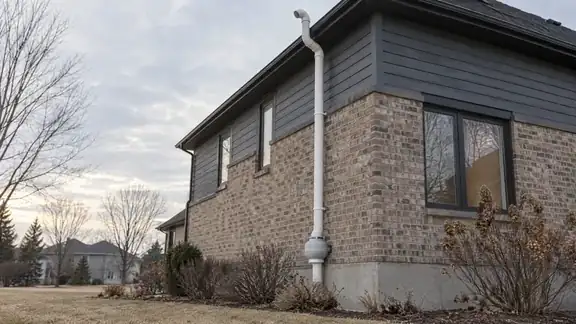
Coring the slab or sealing the sump, running and supporting the pipe, mounting the fan, wiring it to a dedicated circuit, sealing penetrations and labeling the system. Expect the sound of a hammer drill for part of the morning, some concrete dust which we contain and clean, and a pipe on the exterior wall when we leave.
- We protect floors and surfaces before we start
- One to two technicians for a standard install
- You get a walkthrough and a demonstration before we pack up
- 05End of installation dayHandled by us
Commissioning
We confirm the fan is pulling, document the u-tube reading and the pipe route, attach the system label, and explain the two-second monthly check you should make.
- 0624 hours – 30 days afterHandled by us
Verification test
The system does not count as working until a measurement says so. We return and run a post-mitigation test, then send you the result and the comparison against the original reading.
- 07OngoingShared
Year one and beyond
Check the u-tube monthly. Retest every two years, and after any major building change. Radon fans run continuously and are typically replaced between five and ten years; we keep your fan model on file so a swap is straightforward.
What an installation day is really like
Six things people ask about before they book, answered honestly rather than reassuringly. We would rather you were unsurprised than enthusiastic.
- NOISE
- Installation day
Intermittent hammer drilling, mostly during the morning.
- NOISE
- After installation
Usually quieter than a refrigerator, heard outside the room the fan sits near.
- DUST
- Containment
Floor protection, plastic sheeting and a vacuum at the coring point; we clean up after.
- POWER
- Circuit
The fan needs a dedicated circuit; existing panel capacity is checked at inspection.
- LOOK
- Exterior
One pipe on a wall, with a discharge above the eave.
- WATER
- Sump
If a sealed sump lid is fitted, the pit stays functional for drainage.
The whole sequence on one page
- T-01Inquiry to reply
- Within 1 business day
- T-02Short-term test on site
- 2 – 7 days
- T-03Transaction test
- 48 hours minimum
- T-04Laboratory turnaround
- 3 – 7 days
- T-05Inspection to proposal
- 1 – 2 business days
- T-06Installation
- One day, typically 6 – 10 hours
- T-07Verification test
- 24 hours – 30 days after
Timings assume a standard single-family home inside the core service area and a normal laboratory queue. Where a transaction deadline is involved, say so in your first message and we will schedule against the closing date rather than the other way round.
Tell us the property and the deadline
You will get a scheduled window, a fixed price, and a person who answers the phone on installation day.